
|
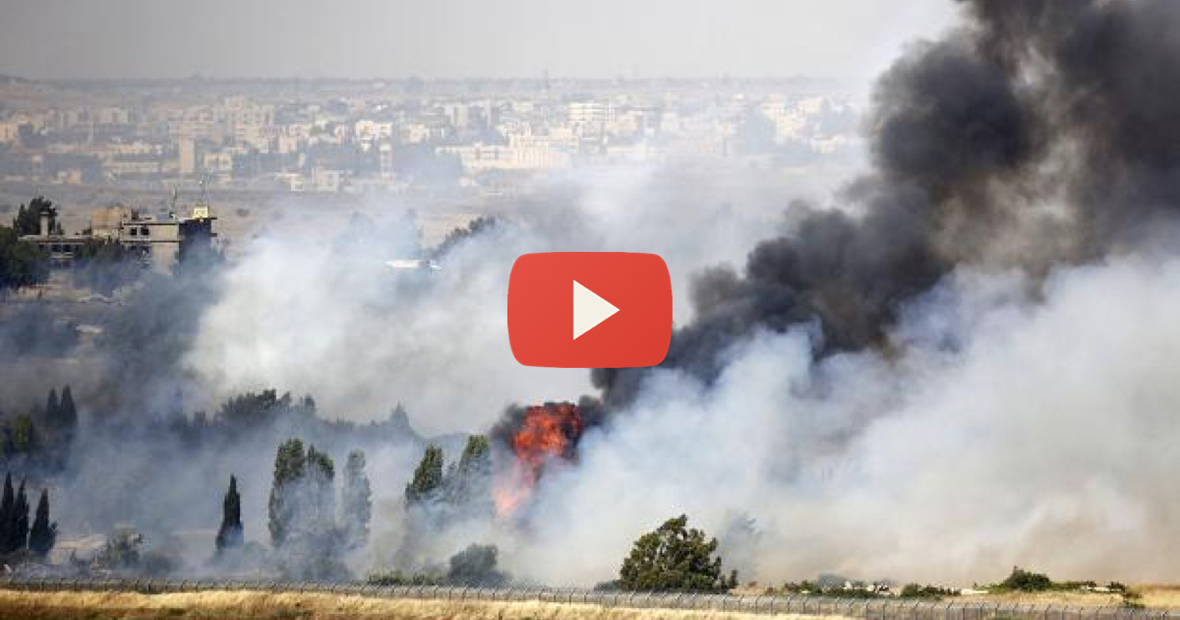
Click here to watch: Assad, Hezbollah, and Iran's Onslaught Towards Israel
A major offensive by the Syrian army in its southern front, in cooperation with Hezbollah and Iranian elements, continued on Fridat, not far from Israel's Golan Heights border. Mere days after the start of the operation, the Syrian Armed Forces declared on Wednesday night that they had made significant achievements in the bloody land battles.
So far, Assad's soldiers, aided by Hassan Nasrallah's Hezbollah fighters, successfully retook three towns in the strategic triangle that lies between the Damascus suburbs, Quneitra suburbs, and Daraa suburbs. These include the villages of Deir al-Adas, Al Dnaj, and Deir Makas, in addition to a number of strategic hills, as seen in the map. Media outlets associated with Assad and Nasrallah have been following events on the front very closely, broadcasting videos of land battles accompanied by heavy artillery, as well as the loot purportedly found in conquered areas.
Hezbollah's Al Manar network claimed on Wednesday that they had found American and Israeli equipment and weaponry alongside an Emirati aid package. Meanwhile, the media outlets have attempted to convey a sense of panic on the part of the rebels and local residents.
Among other things, they reported attempts by rebels to reach an agreement with Assad's forces in the face of defeat. The rebels have tried to limit the damage, claiming that the areas taken by Assad's forces with the help of Hezbollah and Iran are insignificant.
A look at the operation's targets reveals the army's hopes to drive the rebels and al-Nusra front further away from Damascus and its suburbs. They also seek to prevent the rebels in Quneitra and Daraa, who have over the last four years nearly become a united force, from linking up. The army further feels the need to regain control over the area adjacent to the Israeil border and the Quneitra crossing in particular.
The Asharq Alawsat newspaper reported on Thursday morning that a field commander quoted on Syrian national television said: "The military operation launched by the Syrian army in the south continues under the leadership of Syrian President Bashar Assad and in cooperation with the axis of resistance – Hezbollah and Iran."
The Al Mayadeen network has begun referring to the "Syrian army and the resistance" as a single force when referring to the onslaught. Commentators linked to Hezbollah have also been openly admitting that the operation is by the "axis of resistance" and not just the Syrian army.
The most senior is Ibrahim al-Amin, editor of the pro-Hezbollah daily Al Akhbar, who related on Wednesday that the so-called axis already decided to begin the operation to retake southern Syria before the airstrike attributed to Israel. "The decision to prevent southern Syria from falling into the hands of Israel's collaborators is more strategic than any other," he said, "and is equally as important as the decision to prevent Damascus from falling to these same collaborators.
"The decision was made to allocate everything required to make this decision a reality, and everything required in case of escalation of any kind, direct or indirect, that could occur in the region, including the possibility Israel's involvement in further aggressive actions."
Military expect and strategist Amin Hatit, known to be close to Hezbollah, told Asharq Alaswat Thursday morning that "the Golan front currently serves as an example of the first battlefront in which the three components of the axis of resistance (Iran, Syria, and Hezbollah) are operating. The axis is currently testing its capability for joint military action in the field, and it appears that the initial results surpass all expectations.
Within 48 hours, goals were achieved for which ten days were allocated." Hatit explained that the operation has four strategic goals: "The first is to prevent the Israeli buffer zone protected by al-Nusra Front. The second is to consolidate the defense around Damascus.
The third is directly related to the resistance in Lebanon, which is trying to prevent the opening of a southeastern front (near the Lebanese border), which would exhaust it and involve it in a war of attrition.
The fourth goal is to block the American plan to open a war against Syria using the Jordanian option." Meanwhile, in light of the danger posed by the Islamic State group, the Lebanese army – together with Hezbollah – is expected to soon launch a wide-ranging security operation to prevent its advance.
Source: Ynet
|
No comments:
Post a Comment